Posts from the ‘work/life balance’ Category
If I told you there was an easy way to reduce stress, increase your immunity, and even your longevity, without giving up french fries, would you believe it? Volunteering can actually reduce risk of death by 24%. There’s actually research behind this.
I’m sharing this to explain the profound effect volunteering has on your well being. Of course, no one sets out to volunteer based on data or research- we do it because we want to help. Because we are grateful for what we have, and want to give back. Whether you share your knowledge, your time, or your money (or all of the above), it has the added benefit of triggering endorphins and triggers all kinds of positive effects on your biology.
Volunteering has always been an important part of my life, but it became an even greater part when I was grappling with empty nest syndrome.
When my kids moved out, I just worked more. I used distraction as an antidote for the massive volume of quiet in the house. Buried in work, I got through those first few months of wondering what I was going to do with my life, now that my focus wasn’t the tricky balance between work life and planning activities for the kids, college visits, multiple moves in and out of dorms, and the like.
It worked for awhile, but it wasn’t sustainable. Or advisable. So I had to really think about what to do. What did I do with my time before I had kids? What did I WANT to do with all this blank space in my life? How do I get involved with something meaningful, beyond the day to day routine? Before I had kids, I volunteered. Maybe I could do that. But where to start?
Well…as a kid, I loved horses. And I remembered something about equine therapy in the area, so I looked it up. Thus began a weekly routine of volunteering at an equine therapy farm.
I had some romantic idea that it would entail grooming and exercising the horses, or helping with the therapy sessions. Yeah, well, no. What they needed was volunteers to do the hard work of cleaning the the fields and stables (scoop horse poop), stuff bags of hay, fill and carry impossibly heavy buckets of water, and so on. Occasionally, I got to groom the horses and meet the veterans during their sessions. Every time I showed up, the farm cats would come running out of the barn, the horses would amble over to say hello, sometimes playful with each other and rolling in the mud, and it all gave me so much joy. I posted pictures of these boys every week as if they were my kids at the soccer game.
So this back-breaking work, in the sun, in the rain, in the cold, in the sleet…really sucked sometimes- I mean, I’m too old for this shit, really- so what had I gotten myself into? I don’t even do work like that at home! But it was amazing. And surprisingly, I was happier, slept better- and the effect on my work was amazing.
I found myself clearer, less stressed, more confident, and just…more joyful.

This was one of several volunteer gigs I took on. I didn’t think I had time for either, really- but the thing is, you make time for the things that matter. And I found, by making time for meaningful things, I was better at managing and deprioritizing things that weren’t essential. I simply had to plan my time more intentionally.
In The Book of Joy, an extraordinary five day interview with longtime friends, Desmond Tutu and the Dalai Lama, Doug Abrams explores the idea of living joyfully despite hardship and heartbreak. One key concept they share: when you give, you make room to receive, is remarkably true in all kinds of profound ways. In talking about generosity, referencing the research of neuroscientist, Richard Davidson, it says, “the reward centers of our brain light up as strongly when we give as when we receive, sometimes even more so.”
As humans, we are genetically wired to find joy in helping each other. How cool is that?
For inspiration in every aspect of your life, I highly recommend The Book of Joy. You can find it here, or in your local library.
About Jess: Longtime writer, business strategy consultant and one of the original web-mamas (coined by one of my early ecommerce teams), I help companies design and implement strategies to drive growth and improved customer experiences. For more info, see JessJacksonConsulting.com.
The Great Resignation is real. We’re seeing a new mindset for how people think about, and value work.
Millions of people are quitting their jobs- to the tune of 4 million in July 2021 alone, with almost 11 million open jobs at end of July (Ian Cook for HBR, “Who is driving the Great Resignation?“), and in the past 6 months- resignations have accelerated.
Is this really surprising? We’ve had nearly two years of uncertainty, tragedy, and collective trauma with Covid. Now that we’re starting to come out of it, people are re-evaluating what they want. What they need. What matters. And guess what? It’s not working 12 hours a day for lousy pay. It’s not putting your life at risk to go sit in an office, socially distanced from your co-workers.
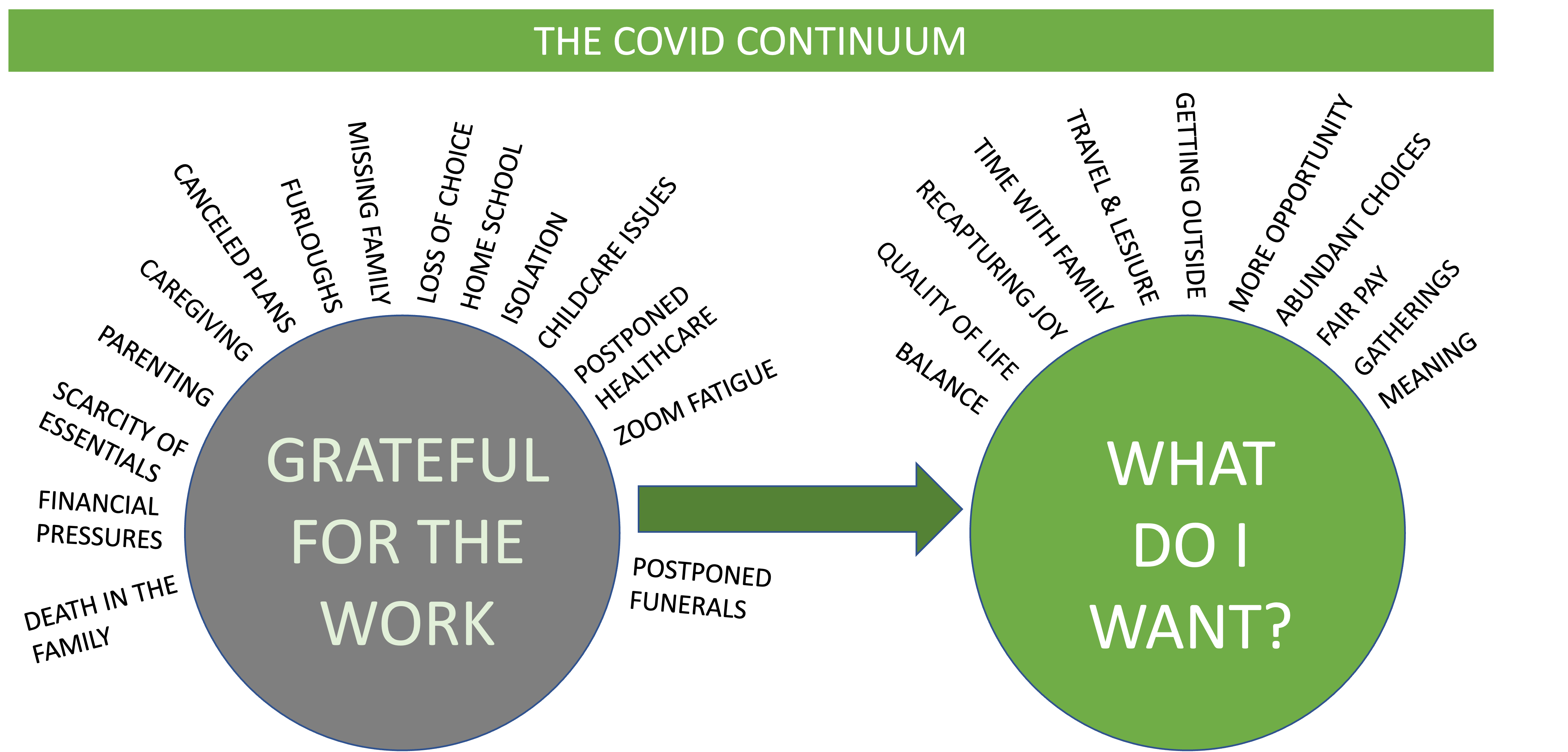
Think about the lowest wage segment- putting their lives at risk every day, in service industries, supply chain and health care- the jobs that could not be done virtually. Parents without other options for childcare simply had to pull out of the market, with schools closed and lack of childcare options. Burnout and exhaustion were a given. There’s a collective trauma- an element of PTSD at play. It’s not surprising these industries are now facing staffing shortages.
For those who were able to work virtually, many were doing the jobs of 1-3 roles, with downsizing, furloughs, and budget cuts over the past 18 months. This, while juggling home-schooling, childcare, family care, isolation, financial stress and more. It’s been a grueling time for those lucky enough to have the work.
As some companies mandate strict ‘back to office’ policies, there’s a real disconnect with employees who don’t want to give up the flexibility of working from home- better balancing their time, and skipping long commutes. They don’t want to go back to the way it was. And they don’t have to.
…”this level of quitting is really an expression of optimism that says, We can do better.”
Derek Thompson for The Atlantic: The Great Resignation is Accelerating.
Derek Thompson talks about the job exodus as a new feeling of empowerment, in his Atlantic article, The Great Resignation Is Accelerating, saying “this level of quitting is really an expression of optimism that says, We can do better.” This is an awakening. Thompson calls it the “Great Reset.” For leaders and managers- it’s an opportunity to evolve and be competitive- or risk continued attrition.
So how do we attract and keep good people? Pay them fairly. Set reasonable expectations. Give them a reason to want to work for you. We all know minimum wage is not a living wage: don’t start there.
It matters more than ever that you’re running a company that listens, and truly cares about your people. Just saying you do isn’t enough. They know the difference.
It matters that you pay what your people are worth.
It matters that you are flexible. Some people simply don’t feel safe coming into the office yet. If you’re not flexible about this, know that others are, and you’re now competing with the entire country- not just your geographic area.
It matters that you make an effort to create paths for growth and advancement.
And more than ever, you need to think about your employees the way you do about your customers: Authenticity, good experience and brand values matter. How your leadership and actions demonstrate these values in every touchpoint with your customers- internal and external, matters. Your customers have a choice. You need to give them a reason to believe in you.
Sources:
The Great Resignation Is Accelerating: Derek Thompson, The Atlantic
Who Is Driving the Great Resignation: Ian Cook, Harvard Business Review
Work-Life Balance
Life/work balance. We all grapple with it. Sometimes it seems as if we’re running too fast on both counts, barely making it between the two- always leaving things undone or in the air. When one aspect of your life becomes overly demanding: (A). sick kid, (B). sick pet, (C). something breaks in the house, (D). someone quits at work, (E). new job, (F). it’s Q4 in the retail industry, or (G). all of the above, it can seem as if you just can’t do it all. And some days, you can’t.
You can be thoughtful and well planned- and still hit that wall. For me, the key has always been to make sure I’m prioritizing based on what’s most important. Sometimes, you have your priorities set, and then BAM: a THING happens. This is where you have to drop the stress of doing IT ALL, and re-prioritize. What do I need to do right now? Figure out how to reorganize the rest later.
Re-prioritizing is important, both because priorities change based on the surprises in our week, but also based on so many other factors. Take the time each night and morning to rethink the day- take a look at the rest of the week, and re-prioritize. If you don’t do this, the risk is that you spend all of your time showing up, reacting, and not focusing on the things that need your utmost and full attention, simply because they’re not the most urgent right now. And yet- you may be continuing to push the more critical, harder tasks out.
There are a million articles, posts, and platitudes around what constitutes balance. Everyone has an opinion. They may say your personal time is your personal time, and you should leave work at the office. Or that you must turn all electronics off after a certain time or your brain activity will go haywire. Or that you need at least 7 hours of sleep or you’ll die young and have reduced brain capacity. The list goes on. Read them, use what resonates for you, and let the rest go. You work every night and on the weekend, but that makes you feel better about how you’re starting your week? Cool. You take 2 hrs for yourself every night and never work on the weekend unless it’s an emergency? Great. The real balance is to do what works for you.
There is no magic bullet for balance in your life. Repeat: THERE IS NO MAGIC BULLET FOR BALANCE.
Again, it’s about prioritizing. What’s most important for me, right now, tonight, tomorrow and this week? What are the things I absolutely cannot miss? Where do I have flex if I need it? What are the conflicts between work/life this week? What are the priorities of those conflicts, and what am I going to do to make it work, i.e. daughter’s ballet recital is non negotiable- well, decision made. Move the work stuff around. CEO meeting is non-negotiable- of course. Move the personal stuff around. See? You have to negotiate with yourself (not the universe of work/life balance philosophers, not anyone who’s judging you or doing it differently), and just, as Tim Gunn says, “Make it work”. Make it work for you.
So, in summary:
- Don’t let your environment, conditions or events completely kidnap your day.
- Don’t let the universe of self-help, theory and linked-in/facebook philosophers tell you what life/work balance is.
- Find what works for YOU, and stick with it.
Don’t let Balance be a bully in your life.


 jess blogs