Sirius XM radio is not my friend anymore.
I broke up with them- a result of economizing and lack of usage. It wasn’t a friendly break-up.
It started out nicely. They kept me going for almost 6 months with incentives to continue the service. I thought it was a great customer retention strategy. When I first tried to cancel, they offered a discounted price for 3 months of service. I said no, thanks. They offered a better price. I said no again. They offered 3 months free. I said yes- why not? This happened twice- each time when I tried to cancel.
At the end of the second 3 months, they billed me about $80 for the following quarter. I sent back the bill asking for the account to be cancelled instead. They started calling my cell phone. The first time they called, they said, “are you aware that there’s a remaining balance of $12.99 on your account?” I cleared that up by telling them I was cancelling my service, and owed nothing. They said I’d have to call a different department to deal with that. So I thought, that’s ok- they’ll see my cancel request in the mail, and sort this all out.
They started calling my cellphone a few times a day. Then 4-8 times of day. Sometimes as late as 9 or 10pm. Each time, with the same, “are you aware…” Over, and over, and over. This happened over a period of several weeks. Every time I’d get home from work and try to call, they would be closed. Finally, I got through- and told them, the calls need to stop. I owe you nothing. You are harassing me. They said, so sorry- we’ll put you on the ‘do not call’ list, take the charges off your account-but it may take a few days.
Several more weeks of stalking followed. The 888 number popping up on my cell phone at all hours of the day- until in frustration, I’d pick up and say, ‘stop stalking me!’.
Eventually, it did stop.
But it was harassment- seriously so.
Clearly, they are desperate to keep subscribers. Early on, the great offers were a wonderful way to surprise and delight, and keep me going- it actually kept me on the service for 6 months longer than I intended. The endless calls with telemarketers that had no idea that I’d already been called a zillion times, were just about the most abhorrent telemarketing onslaught I’ve ever encountered. When I asked one of them why they kept calling, he said, “I’m sorry- a number just pops up on my screen and I have to call it”. They have no idea of the history, of the customer, of the situation. A number just pops up.
This is the antithesis of everything we stand for when we talk about customer service. It’s not going to win anyone back. You have to wonder what XM’s marketing department thought they were going to accomplish in the long-term, by bilking people out of $12.95 as final hurrah, as they sever the relationship. I can picture a bunch of marketing folks in a room, trying to come up with creative ways to make the quarter’s sales goals.
Not a good way to go, Sirius XM, not a good way to go.

Sincerely Ink
How many pictures do you take in a year? Now that we all have smartphones- it’s probably thousands. Tens of thousands, for many of us. But how often do you actually print them? I find that now that everything is digital, I print less and less. I don’t feel the pressure to print and share, and make albums, because I can so easily share my albums online or on facebook, in the instant (and for free).
But sometimes it’s just nice to have a few prints for your mom, for your office- or for the holidays. Well, there’s an app for that. A bunch of them, actually. We’ve been able to share and order prints online for years, but this makes it easier. And a lot more fun.
Sincerely.com has apps for both iphone and android. The newest is Sincerely.ink, launched last fall. With the app, you can create and send a customized print card with photos and your personalized text, for about what it costs to buy a generic card at the drugstore.
Postagram allows you to simply send prints directly from your phone- via email, facebook, twitter- or mail.
My new favorite is the PopBooth app. You can take photos on the fly and turn them into a photo strip- choose color, black and white or sepia- or overlay color filters, and then send prints, email or post your photo strip online. It’s fun stuff. Check it out.

My PopBooth for Jessblogs
Big business brought SOPA and PIPA to Washington, and our big, passionate online community brought ’em down.
In Friday’s New York Times article, “After an online Firestorm, Congress shelves antipiracy bills”, John Weisman writes, “The bills were lobbied for and pushed hard by Hollywood Studios, the recording industry, book publishing, and even the U.S. Chamber of Commerce, as a way to fight rampant piracy online”
But the online communities put up a massive protest. Sites like Wikipedia, Tumblr, Google and many others took a stand against SOPA and PIPA, putting up petitions on the websites, and providing explanations of the bills and implications to the online community. If the bills had passed, we’d no longer be able to talk about and show our favorite movie scenes on our blogs, my daughters would no longer be able to share and enjoy movie spoofs and fan fiction online, I wouldn’t be able to talk about the NYT and HBR on my blog, or show screenshots of favorite websites. In short, our freedom of speech online would be in jeopardy.

Everything is NOT okay. We do NOT approve of SOPA
Big companies pushed hard to get these bills introduced. James Allworth and Maxwell Wessel on the HBR blog, say it like this: “SOPA and PIPA are prime examples of big companies trying to do everything they can to stop new competitors from innovating. They’re also examples of how lobbying in the United States has become one of the most effective ways of limiting this sort of competition.”
Senator Patrick Leahy, Chairman of the Senate Judiciary Committee, and Senator Harry Reid, Senate Majority Leader, would have us believe that PIPA and SOPA are here to protect us. Indeed, Reid says that it would protect thousands of Americans from losing their jobs.
In Weisman’s NYT article, Leahy is quoted as saying:
“More time will pass with jobs lost and economies hurt by foreign criminals who are stealing American intellectual property and selling it back to American consumers. The day will come when the senators who forced this move will look back and realize they made a knee-jerk reaction to a monumental problem,” he added. “Somewhere in China today, in Russia today, and in many other countries that do not respect American intellectual property, criminals who do nothing but peddle in counterfeit products and stolen American content are smugly watching how the United States Senate decided it was not even worth debating how to stop the overseas criminals from draining our economy.”

Congress introduces legislation to
Righhht. That’s why we have so many unemployed people in the U.S. Not because the economy is hosed, and companies are downsizing or not hiring or closing. It sort of reminds me of the post- 9.11 concept that we should deprive Americans of their civil liberties in order to protect us from those who would deprive us of our civil liberties. Got a problem with that? I do. So did 14 million other americans, who contacted their congressmen, signed online petitions, and made their opinions known about the ill-fated bills.
Others have questioned whether the web blackouts of big profile companies like Google and Wikipedia can really be defined as activism. Who cares? Let’s just say it got our attention. It got 14 million Americans taking action to make their voices heard.
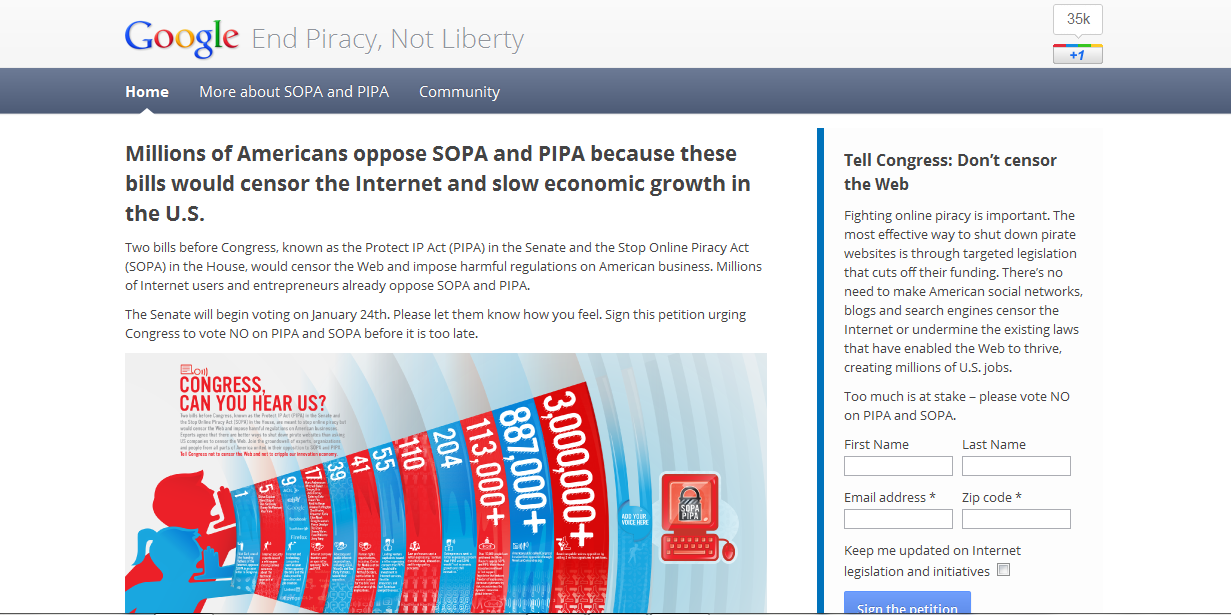
Google's homepage linked to a petition protesting SOPA
Our teenagers and college students see online freedom now as an integral part of their freedom of speech. For them, online censorship would quell creativity, communications, and opinions. The censorship that SOPA and PIPA would cause would hurt them, NOT protect them, nor necessarily protect the big businesses that support it. It is not about saving jobs. It is about censorship. And we cannot allow it.
The real joys of the season are not to be found at Best Buy and Amazon. They are in the random acts of kindness or merriment we see along the way.
Every year, we jump into overdrive in the weeks after thanksgiving, shopping like crazy for family and friends, trying to beat the lines, get the perfect gifts, the deals, and get it all done. Sometimes to the point that we’re stressed, exhausted, and overwhelmed.
Then something wonderful happens.
Something that makes you stop and smile. Like walking up 5th avenue, and seeing two random guys take the microphone from a Salvation Army volunteer, and start singing Christmas carols in harmony. Or giving something away you don’t need, to someone who does. Saying ‘yes’ to the people asking for money- and giving more than they asked for. Giving back, in random ways, gives you more than you can ever imagine.
On the news this morning, there was a story about a ‘secret Santa’ who’s traveling around the country paying off people’s Christmas layaway plans at Kmart and Toys-R-us, especially the ones that had late payments or would be forfeited due to a lack of payments. When one woman encountered her benefactor, and cried in joy, ‘what can I do for you?’, he said, ‘just do the same for someone else’. Is this a single benefactor? Is it a movement? Who knows? It doesn’t matter. It’s just wonderful. In a time of such high unemployment, such struggle with so many things in the world, and people just trying to get by and create some delight for their family, this story is an inspiration.
Let’s do more of that.
Do something wonderful.
The marketers at Coca Cola seem to have forgotten one of the simplest principles of branding, with the recent “Save the Polar Bear” campaign.
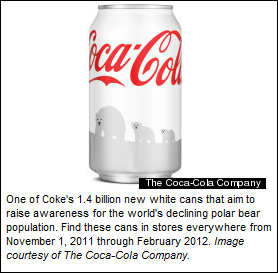
Coca Cola's new can creates a controversy for confused consumers
Shoppers are visual. Our recognition of products is registered in the milliseconds we spend scanning the shelves for what we want. We do not stop to read or examine the things we buy often. We look for what’s familiar, pick it up, and go.
That’s exactly how I ended up drinking about 75 calories worth of a regular coke at lunch, before I got suspicious about the strange taste, looked more closely, and realized the word “diet” was missing. Turns out, lots of people had the same experience. According to the Wall Street Journal, Coca Cola’s response was that the white cans were distinctively different from the silver diet cans.
“Coke says it hasn’t tweaked the taste of its cola and that protecting polar bears is a worthwhile initiative. It recently added a “fact sheet” on its website highlighting how white Coke cans are distinct from silver Diet Coke cans. Among the differences: Regular Coke is labeled “Coca-Cola” and states the calories at the front of the can, while Diet Coke’s holiday can—silver as always—is labeled “Diet Coke” and features snowflakes.” – WSL 12.1.11
Let’s just agree that saving the polar bears is a right and good thing. But Coca Cola, changing the brand identity is confusing and distressing for consumers who feel duped, or annoyed at drinking needless calories. I’d like to have believed after the New Coke flub of 1985, they would have the institutional memory to be cautious about changing the brand too dramatically. Sadly, no.
Coca Cola has a website, Coca Cola Artic Home, dedicated to the Polar Bears, replete with geo-trackers, so you can choose a “virtual parcel” to donate to. It’s a lovely effort, and Coca Cola should be celebrated. But, folks, how did they lose sight of the fact that the people who buy coke and diet coke would be confused? The white can they designed to celebrate the polar bears looks almost identical to the silver diet can. The explanation that the silver is distinct is a clear case of snow-blindness. Perhaps they were too deep in the the artic blizzard to see it.
Tropicana did something similar a few years ago- they decided the brand was looking stale, so they updated the carton so dramatically that it was unrecognizable. They thought it should be more modern, clean, and elegant. The result was so clean that it looked like a generic. And those of us who were Tropicana customers walked right by it looking for the carton with the orange on it. Major brand flub.
There’s been huge consumer uproar about the white can, and Coca Cola has responded by saying that the red cans will be back on the shelves by Christmas.
A brand marketing guy I used to work with used to say, “Fall on your face, not on your ass”, to encourage risk taking on big ideas. I’m not sure which way Coca Cola fell on this one, but it appears that the lesson is learned. At least for now.
Did you know you could buy paper towels on Amazon.com? Bottled water? Laundry detergent? I do now. My sister showed me the mom’s club, where you can subscribe for automatic replenishment to get discounts on things like diapers or laundry detergent. She buys everything online- diapers, cleaning products, hair products- the works. And with free shipping, why not save the trip?
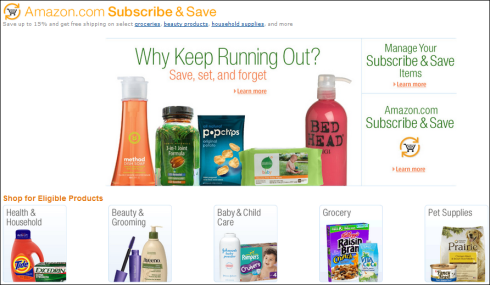
Subscribe to the mom's club on Amazon.com for savings on replenishment products
Until now, I haven’t had much interest in buying groceries online. I dabbled with it during the initial launch of all the online grocer sites, years ago. I couldn’t stand the waste involved with all of the packaging: the laundry detergent came wrapped tightly in cellophane, sunk into a huge box four times it’s size, with loads of those foam peanuts. I ordered two grocery bags worth of stuff, and had enough recycling and garbage to make the garage look like the week after Christmas. Not to mention the size issue. I had never paid much attention to the number of ounces in the average cereal or cracker box- so I ended up with sizes ranging from Brooklyn-corner-store-tiny, to Costco sized gigantic, feed-a-family-of-eight sizes.
But now that I’m commuting again, leaving at 7 and returning after 7, online shopping has a much bigger appeal. I just don’t have enough time to do it all on the weekend.
Last weekend, my sister introduced me to Wag.com, Soap.com– and its associated sites, including diapers.com. Four sites, with a shared cart. Lots of introductory offers, and premium, free 2-day shipping for first time orders. Yesterday I ordered a 35 pound bag of dog food, a 25 pound box of cat litter, a mega-12-pack of paper towels, various organic food items and method soaps, paid nothing for shipping, and it’s all coming tomorrow. Saving the rush trips to store before the weekend is like a gift. Amazon actually owns those sites, too-having acquired the parent company, Quidsi, Inc, for $500 million back in March, but keeps the branding unique and the web design is beautiful. The sites are clean, elegant, and shopper friendly.
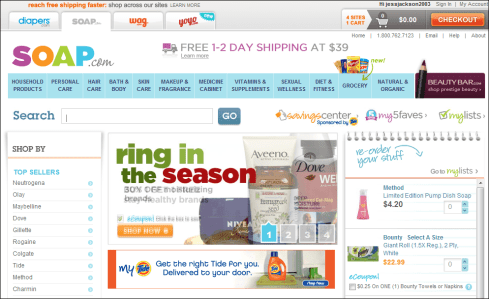
Soap.com remembers what I ordered, and makes it easy to re-order- right from the homepage.
I never thought I’d want to buy paper towels on Amazon. But times have changed. I need easy, now. And getting big, heavy things I need delivered to my door is very, very easy. I’m a convert.
Are you shopping for groceries online? Let me know where you shop, and what you think about the experience.
Retail has become very messy.
It has become a myriad of discounts and ‘exclusive’ events, like the Friends and Family sale, flash sales, sales upon sales, upon sales. I’ve actually started to unsubscribe. The clutter is getting overwhelming, even for me- an inveterate web shopper.
Shoppers are having a field day, now that the entire universe of retail is like one big one-day sale. Want a new pair of pants? There’s a sale for that. New shoes? Wait for the sale. New camera or TV? Just wait for the deals. No one has to pay full price for anything anymore (except maybe orthodontia).
Which is why it is such a delight to see messages from retailers that actually say something. Some good old-fashioned, cogent brand-advertising; something that is actually worth the read. I got one of these today.
It’s an email from Brooks Brothers. What I like about it is that it’s not an in-your-face ‘buy our cashmere because it’s great quality’- pretty much what everyone says. Yes, of course, the ad explains why the cashmere is wonderful. But it draws you in with such a surprising headline, that you actually want to read on. The headline reads:
“The secret to your favorite cashmere sweater and your favorite scotch is the same. It’s in the water.”
It goes on to say,
“What will make our cashmere sweater your favorite? There’s no magic about it– it merely took generations of families on a special riverbank hundreds of years to perfect.”
Oh, is that all. Now they have me engaged. Generations of families? Hundreds of years? A riverbank? It’s starting to sound like an interesting story. Read on- I’ve included the entire email below. Let me know what you think.

Email from Brooks Brothers. Gets your attention in a way most don't anymore.
Is great service a part of your brand?
Every contact counts.
Ever found yourself standing in line at a bank or store watching the people behind the counter chatting to each other about their social lives, previous customers, or completing a task…while you stand there waiting to be acknowledged? Ever have a problem with an account, and have the person on the phone tell you you must have done something wrong? Ever spend what seems like endless minutes working through a voice-response-unit trying to find the option to speak to a human?
Could your brand have any of these moments for your customers? Better find out. Undercover boss has the right idea- go in, and experience what’s really happening. Do it often. You’ll learn not only what is going wrong for your customers, but what obstacles may exist for the staff. Talk to your sales staff and customer service people. Listen in on the phones and observe experiences. Beyond that, you should actually be asking your customers- do the Net Promoter Survey and see if you’re where you want to be. Do some quick user testing and see what customers say about your site experience- you can do it in just a few minutes on Usertesting.com, and have results within hours.
It’s about making every moment count- top to bottom. If your brand and executives believe in great service, but your front-line customer service or sales people do not enthusiastically support and believe in it, it will not happen consistently and brilliantly. Customers need to feel acknowledged, heard, and understood. Your staff also wants to feel acknowledged, heard and understood. It takes empathy, engagement, and sensitivity, to deliver this in both directions. In his book, Setting the Table: The Transforming Power of Hospitality in Business, Danny Meyer sums it up nicely: “Business, like life, is all about how you make people feel. It’s that simple, and it’s that hard”.
It’s prime time. The holiday season starts now.
Motivating shoppers is more challenging than ever. Shoppers are more thoughtful about the purchases they make, and far more likely to shop around for the best offers, policies and site experiences before they take out their wallets.
Getting people to your website is just the first obstacle. Next, you need to give them a reason to care about engaging with your brand- and not just because you have the best price or shipping offer. It’s about branding: delivering value on a meaningful emotional level, to make your website a destination worth bookmarking, and returning to, again and again. Your brand is your most significant competitive advantage. Make sure you’re well positioned with these 5 imperatives, and they will serve you well, long after the Holiday season has passed.
1. Play up your intrinsic brand value. Who are you, and how are you differentiating? Is it a philosophy? An aesthetic? Your policies? Your expertise? If you don’t have the answer, your customers are not likely to find it, either. Spend the time to figure out what it is, and develop content, messaging and events to support it. It can be advice that differentiates you as the expert. It can be your opinion, that positions you as the authority. It can be the aesthetic, with visuals, copy and design that create compelling emotional connection. Consumers need a compelling reason to shop with you. What is yours?
2. Embody the brand, in all that you do. Create a voice and visual language for your brand, and be consistent. Whether it’s a product launch, a sale event, an editorial message, or a customer service email, it should convey a tone and quality that is uniquely you. Shopping is emotional. Any single incongruous communication can create a disconnect that gives your customer pause. Consistency makes your brand believable, dependable, and uniquely appealing. You can continue to react to external factors like the economy, in a way that is motivating, yet uniquely you.
3. Be consistent at every touchpoint. Brand equity is about trust. Without consistency, customers begin to lose faith in you. Without trust, you will lose customer loyalty. Without loyalty…you risk losing repeat customers and brand evangelists who could bring in new traffic. It takes time to gain your customer’s trust in you as a brand, but a single bad experience can jeopardize it. Brand consistency takes vigilance- and training throughout the organization. Your leaders need to know it, nurture it, and police it. Everyone needs to live the brand, in every role, at every level. Start by looking inward: Shop your own site, stores, and print materials often. Call customer service for help with a size or product question. Look for customer service and read the FAQ’s on the website. Make an actual return. Ask yourself: is this a good brand experience?
4. Listen to your customers. They may not always accurately predict their future behavior, but they can tell you how they feel. And how they feel is an important measure of how your brand is doing. Let’s face it: your brand is what your customers think it is. Make sure it’s who you want to be.
5. Make it great. Be the best at what you do, and move it forward. What’s great today, is status-quo tomorrow. So push for what’s the next big, great thing you’ll center your efforts around. Solve a problem your shoppers didn’t know they had. Make it ever-easier to shop. Whether it’s a tool, a value proposition- or an event, make sure that you’re keeping it fresh. It’ll give you something to promote that isn’t about price, and creates a reason for customers to keep coming back. And that’s a win-win for everyone.


 jess blogs