Posts from the ‘consumer behavior’ Category
All this bad press about Mike Jeffries and his reprehensible statements has created a firestorm in social media. Has he gone too far this time? Well, yeah. He always does. But…
Is Abercrombie bad because of what he said, or because of what they do?
Indeed, his comments are awful. While I could argue that Abercrombie’s aspirational brand vision goes too far (something that’s been hotly debated for years- ever since they launched the magalog with naked teens on the cover), it’s not a new marketing tactic to use shock-value to get media attention. Abercrombie has always pushed the limits, and in fact, revels in going over. But they’re not really doing anything new, now. They’ve always marketed the brand for cool, skinny people. They’ve always had teeny-weeny little sizes that could fit your toddler. So why is everyone so hopping mad about it, now?
Because he crossed the line. He didn’t just cross it, he leapt over it. He said what no one would say. And defies the ideals of inclusion, acceptance and diversity. In the 2006 Salon feature that’s been so widely publicized this past few weeks, the interviewer asks him how important “sex and sexual attraction are in what he calls the ’emotional experience’ he creates” and Jeffries says:
“It’s almost everything. That’s why we hire good-looking people in our stores. Because good-looking people attract other good-looking people, and we want to market to cool, good-looking people. We don’t market to anyone other than that.”
“In every school there are the cool and popular kids, and then there are the not-so-cool kids,” he says. “Candidly, we go after the cool kids. We go after the attractive all-American kid with a great attitude and a lot of friends. A lot of people don’t belong [in our clothes], and they can’t belong. Are we exclusionary? Absolutely. Those companies that are in trouble are trying to target everybody: young, old, fat, skinny. But then you become totally vanilla. You don’t alienate anybody, but you don’t excite anybody, either.”
(“The man behind Abercrombie & Fitch“, Benoit Denizet-Lewis for Salon, 2006)
Is this exclusionary strategy so different from other high profile fashion brands? Or is he just brutally honest? Let’s focus on the sizing issue. Abercrombie’s sizing is notoriously small. It doesn’t carry extra large sizes for women at all. Even the men’s sizes are downsized: a men’s size XL sweatshirt fits like a women’s size 12.
If you look at the sizing for many upscale fashion retail brands, it’s not really that different. Abercrombie defines a Large as equivalent to a size 10. Many fashion brands define a large as a size 10-12. Some go even smaller, defining it as an 8-10. And others (the less trendy) define it as a 12-14 or even a 14-16. There’s no standardization for sizing, and we all know it, as frustrating as it is. It always differs by brand. Some are just cut slim- others more generous. We all know the brands we can wear, and the ones we can’t. So Abercrombie is hardly unique when it comes to size range.
Considering the brand issue, Abercrombie is not unique in having a passionate and specific vision of its aspirational lifestyle and target customer. Countless fashion brands have an aspirational look that celebrates, young, thin, beautiful women, with a target customer that exemplifies the aspirational lifestyle. That’s not news. The key difference? Most brands don’t celebrate the exclusion. What’s hateful about the Jeffrie’s incident is that he didn’t focus on what’s good about his brand- he focused on what’s bad about the people that don’t fit into his brand image. And that’s bad business.
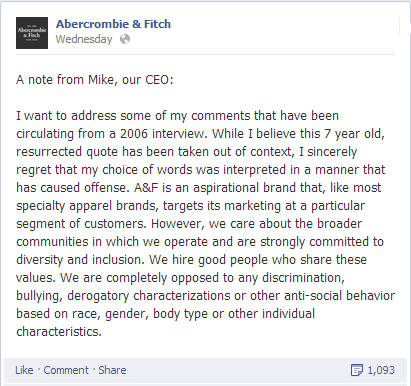
Jeffries has since posted an apology on facebook that reads:
“I want to address some of my comments that have been circulating from a 2006 interview. While I believe this 7 year old, resurrected quote has been taken out of context, I sincerely regret that my choice of words was interpreted in a manner that has caused offense. A&F is an aspirational brand that, like most specialty apparel brands, targets its marketing at a particular segment of customers. However, we care about the broader communities in which we operate and are strongly committed to diversity and inclusion. We hire good people who share these values. We are completely opposed to any discrimination, bullying, derogatory characterizations or other anti-social behavior based on race, gender, body type or other individual characteristics.”
This isn’t the first time Jeffries has hurt the brand he worked so hard to build. He’s been dragged through the mud on many other occasions for discrimation against…well, just about every group except his target audience. So far, Abercrombie has always weathered the storm. But I wonder, will the cool kids really want to keep buying into this? Time will tell.
Everything we do online is tracked- by someone, or some entity. We all know it. Mostly, we accept it.
I don’t get too worked up about it. On the business side, retailers see it as a way to create a better experience for you. Executed thoughtfully, it can be. For example, if you come to a website and look at brand “A”, and add something from brand “A” to your cart, the retailer may send you emails about “brand A” in the future, knowing that it’s something that has interested you. This isn’t such a bad thing, though sometimes it can be misguided (as when you send someone a gift from a website that you also shop for yourself, and forever after get emails about that gift product or brand that you have no further interest in).
I’m not terribly offended by ‘stalker’ ads- banner ads from retailers, which seem to follow you around as you browse news sites or content sites, showing you an ad based on products you’ve recently viewed on a given website. I don’t mind these, because they seem like they could be a coincidence. I don’t even mind getting an email from a retailer I’ve visited recently, showing me the product or brands I’ve looked at. Could also be a coincidence…although a little spooky when it’s exactly what I was looking at. And when I’ve added things to my cart, and then left the site, I don’t mind getting the email saying, “we’ve saved your cart for you.” It seems credible that they know I have an interest in that stuff. Of course they just want to capture the sale. But maybe that’s ok- maybe I want to complete the purchase. Especially if they include a shipping or cart discount to encourage me.
Most retailers are careful to stay within the limits of what’s legal or within best-practices for protecting customer privacy. But there’s fuzzy territory when retailers try new things, or cross the line between what seems reasonable, and what seems invasive. What I mind, is when it all seems a bit too purposeful. A bit too obvious. When you think you’re anonymous, and then get called out by the retailer on it. Here’s an example:
I recently visited a website, looked around, and left. Never signed-in. A little while later, I get an email saying, “Glad you checked us out! Come on back….”
That’s just creepy.
Anonymity doesn’t exist anymore, online. There are measures we can take to protect our privacy, to a degree. If you block cookies, or clear cookies before shopping a website, the session can’t be tracked. But this isn’t top of mind on a daily basis, both because there’s not usually a problem, and because clearing cookies is inconvenient. At the end of the day, retailers are just trying to make money. And I want them to. Because then there are lots of jobs for lots of people.
So retailers: don’t forget you make money by making your customers feel good about you: your brand, your stuff, andIs a the experience. Don’t make me feel like you’re looking over my shoulder- or I won’t want to come to your store anymore. It’s that simple. I expect my information to be treated fairly, and thoughtfully.
And readers…What privacy issues rankle you most? How has it changed what you do online, if at all? I’d be interested in your experiences with privacy (or lack thereof).
The dreaded VRU. How did it come to be such a brick wall? It’s a great tool for efficiency, of course- just not for us. No doubt it saves millions in staffing costs for companies, while creating a tedious, frustrating, and mind-numbing experience for those of us who spend infinitely more time navigating through the gauntlet of menus, only to find that none of them offer the right options- none offer a human. I’ll start to feel my blood pressure rising, the frustration growing, finally talking louder and louder to the VRU, as if I were talking to someone hard of hearing, saying, “I WANT A HUMAN!”, then getting the inevitably even-toned “I’m sorry, that is not a valid response. To return to the main menu, please press 1, now”.
It wouldn’t be so bad if there were always the option to speak to an agent, but many companies remove that option. Others offer it, but only after you’ve followed a path of automated responses that exhaust all possible functions the system has in its arsenal. The thing is, I don’t actually want to speak to a human. I’d much rather be able to solve everything through email or online. But sometimes, you can’t- and you really need to speak with someone, and it just shouldn’t have to be so hard.
Used the way they were intended, VRU’s have a place, providing answers to frequently asked questions, saving time and money- theoretically leaving more time for qualified agents to deal with more complicated issues. I get it. They can be a tolerable evil, to a degree, as long as there’s always the option to speak to someone. It’s just plain irresponsible to omit an option to do so.
In the early days of web shopping, you practically had to have connections to get a phone number at Amazon. There was one- but you could not find it on the site. It simply wasn’t there. When my friend AMB got the number- it was a big score- and we all saved it in our address books for future reference. It was like having privileged information. They’ve come a long way since those days.
Even now, there are a surprising number of high-profile companies that don’t provide phone service at all. Companies that just can’t handle the volume, or plain don’t want to. Some surprisingly big companies in the mix. See “Tech Companies Leave Phone Calls Behind” in yesterday’s New York Times- Quora doesn’t provide a phone number at all. Twitter has one, but it hangs up after directing you to email. Facebook is no better. In the article, Amy O’Leary describes the Linked In VRU cycle as a telephonic version of “Groundhog Day”. That pretty much sums it up.
And then…there are the times that speaking to an agent seems almost as existential as working your way through a VPU. Check out “The Theater of the Absurd” today in the NYT business section, for a humorous article on the subject, including a transcript of a baffling conversation between Alan Alda and a McAfee customer service agent, in which he says to her, “I am now in the land of Kafka” after going around in ridiculous circles. Worth a read.
I wonder if Siri could help. Try asking her to get you an agent at <company name here>, and see what happens. Let me know how that works out. I’m a generation behind, on the iPhone 4, so wouldn’t know. It would be worth the upgrade if she has that kind of power.
Making your brand extraordinary isn’t about the grand gestures. You don’t have to be a $500 million company to create meaningful moments for your customers. And you can be any size at all to fail your customers in the blink of an eye.
A pass? Providing your full attention in the moment. Acknowledging the customer who is waiting. Saying ‘thank you’. A little surprise, like a Reward card or a sample in the box. Saying ‘yes’ instead of ‘no’.
Epic fail? A scornful response to an angry or annoying customer. Thinking the customer is stupid. Not finding it important to make each contact a positive one. Forgetting that the customer is why you get paid to show up at all.
We always say it’s the little things that make a difference, and yet it’s so easy to forget as we go about our days, with all the accumulated stresses and pressures that we’re dealing with, to make the effort to listen, to really hear, and to respond thoughtfully and generously. The people and companies that become legendary are the ones who are able to make the minutes count. Even the bad ones. But how do they do it? It starts with a clear, focused mission that puts the customer at the forefront. Consistent performance. A culture that sustains thoughtfulness as a value, even behind the scenes.
Have you every noticed how delighted you are when someone gives you what you want, right away, with a smile- even when you want to return something too late, or with the tags off, or you’re being antagonistic because you expect a ‘no’, and then you get a friendly ‘yes’? It’s a nice surprise. It can make you feel so great about an experience, and yet it’s really just such a small thing. It’s not easy to be that person who smiles and remains friendly when someone’s being difficult and antagonistic, when viscerally, you just want to respond in kind.
That’s what makes it special. It’s harder to be nice sometimes, but it’s a win-win for everyone. For a brand, it can create buzz. It can make you remarkable. And your customers will so happily want to bring friends to you, because it’s surprising and wonderful, and makes a difference in their day.
It reminds me of something that happened last week on the way home. Every day I commute to and from work on the bus. I completely zone out, reading or sleeping the entire way home. It’s the same, day after day. Except one night, last week, we pulled to the back of the parking lot, where the headlights showed a racoon- yes, a real racoon, standing inside a plastic storage box turned sideways, eating out of a Chinese food container. The next night, he was there again, eating from a new one. Now, every few days, we drive that way to see if he’s home. And usually, if we’re there at the same time, he is. Someone is bringing Chinese food to that Racoon. Or he’s having it delivered. Or he’s found a friendly, neighborhood garbage to raid. The point is- it was an extraordinary thing to see in the vast paved parking lot with hundreds of cars and people going about their daily commute. Just hanging out, in all his fuzzy glory, eating his lo mein.
It made us smile. And we’ve talked about it ever since. But really, it was just a racoon. What’s so special about that? It’s just that it was so unexpected. So out of context. It was remarkable.
A great customer experience is like that Racoon. It becomes something worth talking about.
Sirius XM radio is not my friend anymore.
I broke up with them- a result of economizing and lack of usage. It wasn’t a friendly break-up.
It started out nicely. They kept me going for almost 6 months with incentives to continue the service. I thought it was a great customer retention strategy. When I first tried to cancel, they offered a discounted price for 3 months of service. I said no, thanks. They offered a better price. I said no again. They offered 3 months free. I said yes- why not? This happened twice- each time when I tried to cancel.
At the end of the second 3 months, they billed me about $80 for the following quarter. I sent back the bill asking for the account to be cancelled instead. They started calling my cell phone. The first time they called, they said, “are you aware that there’s a remaining balance of $12.99 on your account?” I cleared that up by telling them I was cancelling my service, and owed nothing. They said I’d have to call a different department to deal with that. So I thought, that’s ok- they’ll see my cancel request in the mail, and sort this all out.
They started calling my cellphone a few times a day. Then 4-8 times of day. Sometimes as late as 9 or 10pm. Each time, with the same, “are you aware…” Over, and over, and over. This happened over a period of several weeks. Every time I’d get home from work and try to call, they would be closed. Finally, I got through- and told them, the calls need to stop. I owe you nothing. You are harassing me. They said, so sorry- we’ll put you on the ‘do not call’ list, take the charges off your account-but it may take a few days.
Several more weeks of stalking followed. The 888 number popping up on my cell phone at all hours of the day- until in frustration, I’d pick up and say, ‘stop stalking me!’.
Eventually, it did stop.
But it was harassment- seriously so.
Clearly, they are desperate to keep subscribers. Early on, the great offers were a wonderful way to surprise and delight, and keep me going- it actually kept me on the service for 6 months longer than I intended. The endless calls with telemarketers that had no idea that I’d already been called a zillion times, were just about the most abhorrent telemarketing onslaught I’ve ever encountered. When I asked one of them why they kept calling, he said, “I’m sorry- a number just pops up on my screen and I have to call it”. They have no idea of the history, of the customer, of the situation. A number just pops up.
This is the antithesis of everything we stand for when we talk about customer service. It’s not going to win anyone back. You have to wonder what XM’s marketing department thought they were going to accomplish in the long-term, by bilking people out of $12.95 as final hurrah, as they sever the relationship. I can picture a bunch of marketing folks in a room, trying to come up with creative ways to make the quarter’s sales goals.
Not a good way to go, Sirius XM, not a good way to go.
The real joys of the season are not to be found at Best Buy and Amazon. They are in the random acts of kindness or merriment we see along the way.
Every year, we jump into overdrive in the weeks after thanksgiving, shopping like crazy for family and friends, trying to beat the lines, get the perfect gifts, the deals, and get it all done. Sometimes to the point that we’re stressed, exhausted, and overwhelmed.
Then something wonderful happens.
Something that makes you stop and smile. Like walking up 5th avenue, and seeing two random guys take the microphone from a Salvation Army volunteer, and start singing Christmas carols in harmony. Or giving something away you don’t need, to someone who does. Saying ‘yes’ to the people asking for money- and giving more than they asked for. Giving back, in random ways, gives you more than you can ever imagine.
On the news this morning, there was a story about a ‘secret Santa’ who’s traveling around the country paying off people’s Christmas layaway plans at Kmart and Toys-R-us, especially the ones that had late payments or would be forfeited due to a lack of payments. When one woman encountered her benefactor, and cried in joy, ‘what can I do for you?’, he said, ‘just do the same for someone else’. Is this a single benefactor? Is it a movement? Who knows? It doesn’t matter. It’s just wonderful. In a time of such high unemployment, such struggle with so many things in the world, and people just trying to get by and create some delight for their family, this story is an inspiration.
Let’s do more of that.
Do something wonderful.
The marketers at Coca Cola seem to have forgotten one of the simplest principles of branding, with the recent “Save the Polar Bear” campaign.
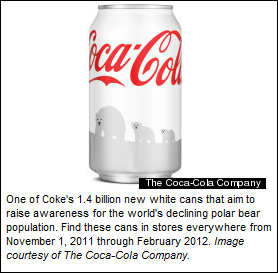
Coca Cola's new can creates a controversy for confused consumers
Shoppers are visual. Our recognition of products is registered in the milliseconds we spend scanning the shelves for what we want. We do not stop to read or examine the things we buy often. We look for what’s familiar, pick it up, and go.
That’s exactly how I ended up drinking about 75 calories worth of a regular coke at lunch, before I got suspicious about the strange taste, looked more closely, and realized the word “diet” was missing. Turns out, lots of people had the same experience. According to the Wall Street Journal, Coca Cola’s response was that the white cans were distinctively different from the silver diet cans.
“Coke says it hasn’t tweaked the taste of its cola and that protecting polar bears is a worthwhile initiative. It recently added a “fact sheet” on its website highlighting how white Coke cans are distinct from silver Diet Coke cans. Among the differences: Regular Coke is labeled “Coca-Cola” and states the calories at the front of the can, while Diet Coke’s holiday can—silver as always—is labeled “Diet Coke” and features snowflakes.” – WSL 12.1.11
Let’s just agree that saving the polar bears is a right and good thing. But Coca Cola, changing the brand identity is confusing and distressing for consumers who feel duped, or annoyed at drinking needless calories. I’d like to have believed after the New Coke flub of 1985, they would have the institutional memory to be cautious about changing the brand too dramatically. Sadly, no.
Coca Cola has a website, Coca Cola Artic Home, dedicated to the Polar Bears, replete with geo-trackers, so you can choose a “virtual parcel” to donate to. It’s a lovely effort, and Coca Cola should be celebrated. But, folks, how did they lose sight of the fact that the people who buy coke and diet coke would be confused? The white can they designed to celebrate the polar bears looks almost identical to the silver diet can. The explanation that the silver is distinct is a clear case of snow-blindness. Perhaps they were too deep in the the artic blizzard to see it.
Tropicana did something similar a few years ago- they decided the brand was looking stale, so they updated the carton so dramatically that it was unrecognizable. They thought it should be more modern, clean, and elegant. The result was so clean that it looked like a generic. And those of us who were Tropicana customers walked right by it looking for the carton with the orange on it. Major brand flub.
There’s been huge consumer uproar about the white can, and Coca Cola has responded by saying that the red cans will be back on the shelves by Christmas.
A brand marketing guy I used to work with used to say, “Fall on your face, not on your ass”, to encourage risk taking on big ideas. I’m not sure which way Coca Cola fell on this one, but it appears that the lesson is learned. At least for now.
Did you know you could buy paper towels on Amazon.com? Bottled water? Laundry detergent? I do now. My sister showed me the mom’s club, where you can subscribe for automatic replenishment to get discounts on things like diapers or laundry detergent. She buys everything online- diapers, cleaning products, hair products- the works. And with free shipping, why not save the trip?
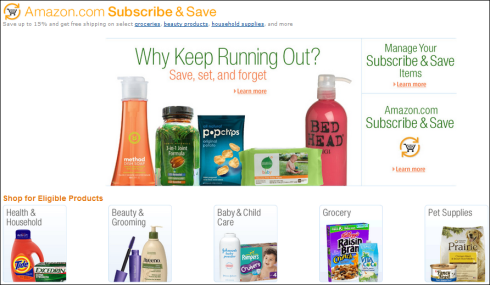
Subscribe to the mom's club on Amazon.com for savings on replenishment products
Until now, I haven’t had much interest in buying groceries online. I dabbled with it during the initial launch of all the online grocer sites, years ago. I couldn’t stand the waste involved with all of the packaging: the laundry detergent came wrapped tightly in cellophane, sunk into a huge box four times it’s size, with loads of those foam peanuts. I ordered two grocery bags worth of stuff, and had enough recycling and garbage to make the garage look like the week after Christmas. Not to mention the size issue. I had never paid much attention to the number of ounces in the average cereal or cracker box- so I ended up with sizes ranging from Brooklyn-corner-store-tiny, to Costco sized gigantic, feed-a-family-of-eight sizes.
But now that I’m commuting again, leaving at 7 and returning after 7, online shopping has a much bigger appeal. I just don’t have enough time to do it all on the weekend.
Last weekend, my sister introduced me to Wag.com, Soap.com– and its associated sites, including diapers.com. Four sites, with a shared cart. Lots of introductory offers, and premium, free 2-day shipping for first time orders. Yesterday I ordered a 35 pound bag of dog food, a 25 pound box of cat litter, a mega-12-pack of paper towels, various organic food items and method soaps, paid nothing for shipping, and it’s all coming tomorrow. Saving the rush trips to store before the weekend is like a gift. Amazon actually owns those sites, too-having acquired the parent company, Quidsi, Inc, for $500 million back in March, but keeps the branding unique and the web design is beautiful. The sites are clean, elegant, and shopper friendly.
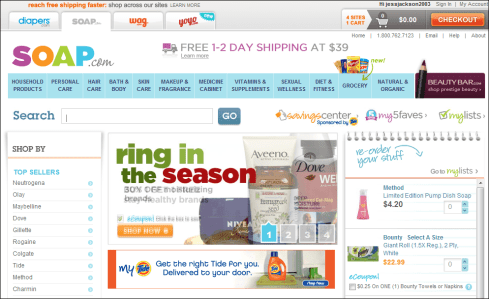
Soap.com remembers what I ordered, and makes it easy to re-order- right from the homepage.
I never thought I’d want to buy paper towels on Amazon. But times have changed. I need easy, now. And getting big, heavy things I need delivered to my door is very, very easy. I’m a convert.
Are you shopping for groceries online? Let me know where you shop, and what you think about the experience.
Retail has become very messy.
It has become a myriad of discounts and ‘exclusive’ events, like the Friends and Family sale, flash sales, sales upon sales, upon sales. I’ve actually started to unsubscribe. The clutter is getting overwhelming, even for me- an inveterate web shopper.
Shoppers are having a field day, now that the entire universe of retail is like one big one-day sale. Want a new pair of pants? There’s a sale for that. New shoes? Wait for the sale. New camera or TV? Just wait for the deals. No one has to pay full price for anything anymore (except maybe orthodontia).
Which is why it is such a delight to see messages from retailers that actually say something. Some good old-fashioned, cogent brand-advertising; something that is actually worth the read. I got one of these today.
It’s an email from Brooks Brothers. What I like about it is that it’s not an in-your-face ‘buy our cashmere because it’s great quality’- pretty much what everyone says. Yes, of course, the ad explains why the cashmere is wonderful. But it draws you in with such a surprising headline, that you actually want to read on. The headline reads:
“The secret to your favorite cashmere sweater and your favorite scotch is the same. It’s in the water.”
It goes on to say,
“What will make our cashmere sweater your favorite? There’s no magic about it– it merely took generations of families on a special riverbank hundreds of years to perfect.”
Oh, is that all. Now they have me engaged. Generations of families? Hundreds of years? A riverbank? It’s starting to sound like an interesting story. Read on- I’ve included the entire email below. Let me know what you think.

Email from Brooks Brothers. Gets your attention in a way most don't anymore.
Is great service a part of your brand?
Every contact counts.
Ever found yourself standing in line at a bank or store watching the people behind the counter chatting to each other about their social lives, previous customers, or completing a task…while you stand there waiting to be acknowledged? Ever have a problem with an account, and have the person on the phone tell you you must have done something wrong? Ever spend what seems like endless minutes working through a voice-response-unit trying to find the option to speak to a human?
Could your brand have any of these moments for your customers? Better find out. Undercover boss has the right idea- go in, and experience what’s really happening. Do it often. You’ll learn not only what is going wrong for your customers, but what obstacles may exist for the staff. Talk to your sales staff and customer service people. Listen in on the phones and observe experiences. Beyond that, you should actually be asking your customers- do the Net Promoter Survey and see if you’re where you want to be. Do some quick user testing and see what customers say about your site experience- you can do it in just a few minutes on Usertesting.com, and have results within hours.
It’s about making every moment count- top to bottom. If your brand and executives believe in great service, but your front-line customer service or sales people do not enthusiastically support and believe in it, it will not happen consistently and brilliantly. Customers need to feel acknowledged, heard, and understood. Your staff also wants to feel acknowledged, heard and understood. It takes empathy, engagement, and sensitivity, to deliver this in both directions. In his book, Setting the Table: The Transforming Power of Hospitality in Business, Danny Meyer sums it up nicely: “Business, like life, is all about how you make people feel. It’s that simple, and it’s that hard”.


 jess blogs