Posts from the ‘Uncategorized’ Category
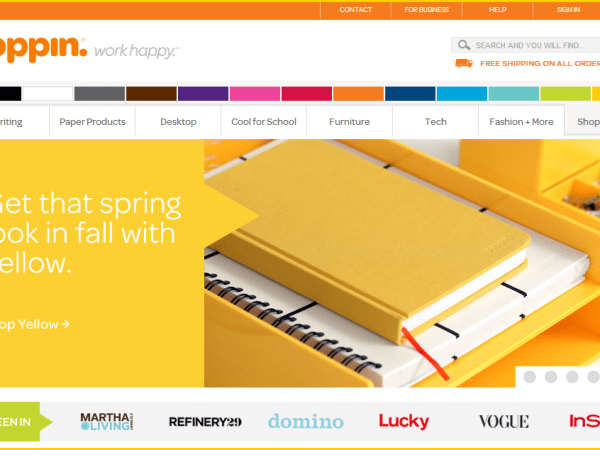
Think old-school office supplies are on the way out? Paperless offices, Evernote, iPads, laptops, iPhones- there are so many ways to plug in and make your to-do’s a scheduled reminder list, your notes an archivable, searchable library on Evernote, or a quick email after a meeting. But the truth is, there are die-hard note-takers out here. There are paper lovers and pen collectors. There are those of us who are on a never-ending quest for the perfect pen, the perfect notebook- the proverbial blank page that invites and inspires and satisfies as you check off your to-do list, like no program, application or device can.
This is where Poppin comes in.

Who says office supplies need to be black? Poppin’s site is all about color.
Of course, we need our technology, and we love that too. This is different. This is love at first sight.
Poppin’s tagline is “work happy”, and everything about the website reflects it. The copy is light-hearted and friendly- The people you can call for help are called “work stylists” who can set you up with a desk to love. On the Help page, the stylists are described this way:
“Each Poppin Work Stylist has been carefully chosen because they like to smile, have exquisite taste and looooove talking to people.”
The website itself is entertaining, fun and has a great design sensibility- you can shop visually by color as a secondary navigation bar at the top of the site. The copy is believable and genuine, with a sense of humor. They “pinky-promise to take any Poppin product back that does not make you work happy.”
The branding is superb, end-to-end. The package arrives with writing on the outside, and air-bubbles on the inside printed with funny quotes. You actually want to save the air bubbles- they’re that cute. And a week or two after my package arrived, I got a hand-written thank you note on a Poppin card, mentioning my specific items.
All in all, it’s a complete delight. It’s not to say we won’t keep using Evernote and iPads and laptops. But it doesn’t hurt to have a desk that makes you smile everyday. Check it out at Poppin.com.
The dreaded VRU. How did it come to be such a brick wall? It’s a great tool for efficiency, of course- just not for us. No doubt it saves millions in staffing costs for companies, while creating a tedious, frustrating, and mind-numbing experience for those of us who spend infinitely more time navigating through the gauntlet of menus, only to find that none of them offer the right options- none offer a human. I’ll start to feel my blood pressure rising, the frustration growing, finally talking louder and louder to the VRU, as if I were talking to someone hard of hearing, saying, “I WANT A HUMAN!”, then getting the inevitably even-toned “I’m sorry, that is not a valid response. To return to the main menu, please press 1, now”.
It wouldn’t be so bad if there were always the option to speak to an agent, but many companies remove that option. Others offer it, but only after you’ve followed a path of automated responses that exhaust all possible functions the system has in its arsenal. The thing is, I don’t actually want to speak to a human. I’d much rather be able to solve everything through email or online. But sometimes, you can’t- and you really need to speak with someone, and it just shouldn’t have to be so hard.
Used the way they were intended, VRU’s have a place, providing answers to frequently asked questions, saving time and money- theoretically leaving more time for qualified agents to deal with more complicated issues. I get it. They can be a tolerable evil, to a degree, as long as there’s always the option to speak to someone. It’s just plain irresponsible to omit an option to do so.
In the early days of web shopping, you practically had to have connections to get a phone number at Amazon. There was one- but you could not find it on the site. It simply wasn’t there. When my friend AMB got the number- it was a big score- and we all saved it in our address books for future reference. It was like having privileged information. They’ve come a long way since those days.
Even now, there are a surprising number of high-profile companies that don’t provide phone service at all. Companies that just can’t handle the volume, or plain don’t want to. Some surprisingly big companies in the mix. See “Tech Companies Leave Phone Calls Behind” in yesterday’s New York Times- Quora doesn’t provide a phone number at all. Twitter has one, but it hangs up after directing you to email. Facebook is no better. In the article, Amy O’Leary describes the Linked In VRU cycle as a telephonic version of “Groundhog Day”. That pretty much sums it up.
And then…there are the times that speaking to an agent seems almost as existential as working your way through a VPU. Check out “The Theater of the Absurd” today in the NYT business section, for a humorous article on the subject, including a transcript of a baffling conversation between Alan Alda and a McAfee customer service agent, in which he says to her, “I am now in the land of Kafka” after going around in ridiculous circles. Worth a read.
I wonder if Siri could help. Try asking her to get you an agent at <company name here>, and see what happens. Let me know how that works out. I’m a generation behind, on the iPhone 4, so wouldn’t know. It would be worth the upgrade if she has that kind of power.
Abysmal writing in business is a terrible thing. Besides being unpleasant to read, it can instantly strip away your credibility as a cause, a brand or a company.
Sure, the advertising and retail world take a little license to play with the English language to make a point, or to create a more powerful message. But that’s intentional, so we give it a pass (to a point).
Bad spelling, misuse of words, or flat out bad grammar can hurt you. It makes you look unprofessional. It makes your message look careless and sloppy. Organizations looking to print, publish or launch something online, thinking perhaps they’re saving a few dollars by writing it themselves, well, they’re not saving anything in the end. They’re losing credibility. They’d be much better served by calling the people out there who make a living doing it.
Here’s a striking example. I got a letter from a local not-for-profit organization, working to protect open space. The header sets the tone for the entire piece, screaming, “DO NOT EXCEPT FALSE CHOICES ON TAXES”. Later in the letter, there’s a sentence saying, “If you were lead to believe…”
The entire letter is riddled with errors- grammatical, spelling, bad word usage. It’s embarrassing. The letter is signed by a Ph.D and a Lawyer. So either they never took the grammar unit in high school, or perhaps a volunteer wrote it- who knows. The point is, they signed it. If your name is on it, you need to read it.
The other thing to avoid is superfluous formatting: excessive use of capital letters, colors, underlines and bold type- by emphasizing lots of things, they end up featuring nothing. It’s just ugly and sensationalistic. This seems to be a common, yet unfortunate method many direct mailers use to try to get our attention. It does. But not in a good way.
This is an extreme example, but I can’t tell you how often I see grammatical and misspellings in business and upscale retail communications. If you have a brand to protect, and an important message to share- take the time to make it good. Your message will resonate if it’s written well. Or at least have a fighting chance.
The unfortunate mailer:

bad writing works against a local non-profit organization
The real joys of the season are not to be found at Best Buy and Amazon. They are in the random acts of kindness or merriment we see along the way.
Every year, we jump into overdrive in the weeks after thanksgiving, shopping like crazy for family and friends, trying to beat the lines, get the perfect gifts, the deals, and get it all done. Sometimes to the point that we’re stressed, exhausted, and overwhelmed.
Then something wonderful happens.
Something that makes you stop and smile. Like walking up 5th avenue, and seeing two random guys take the microphone from a Salvation Army volunteer, and start singing Christmas carols in harmony. Or giving something away you don’t need, to someone who does. Saying ‘yes’ to the people asking for money- and giving more than they asked for. Giving back, in random ways, gives you more than you can ever imagine.
On the news this morning, there was a story about a ‘secret Santa’ who’s traveling around the country paying off people’s Christmas layaway plans at Kmart and Toys-R-us, especially the ones that had late payments or would be forfeited due to a lack of payments. When one woman encountered her benefactor, and cried in joy, ‘what can I do for you?’, he said, ‘just do the same for someone else’. Is this a single benefactor? Is it a movement? Who knows? It doesn’t matter. It’s just wonderful. In a time of such high unemployment, such struggle with so many things in the world, and people just trying to get by and create some delight for their family, this story is an inspiration.
Let’s do more of that.
Do something wonderful.
The marketers at Coca Cola seem to have forgotten one of the simplest principles of branding, with the recent “Save the Polar Bear” campaign.
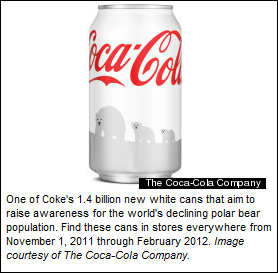
Coca Cola's new can creates a controversy for confused consumers
Shoppers are visual. Our recognition of products is registered in the milliseconds we spend scanning the shelves for what we want. We do not stop to read or examine the things we buy often. We look for what’s familiar, pick it up, and go.
That’s exactly how I ended up drinking about 75 calories worth of a regular coke at lunch, before I got suspicious about the strange taste, looked more closely, and realized the word “diet” was missing. Turns out, lots of people had the same experience. According to the Wall Street Journal, Coca Cola’s response was that the white cans were distinctively different from the silver diet cans.
“Coke says it hasn’t tweaked the taste of its cola and that protecting polar bears is a worthwhile initiative. It recently added a “fact sheet” on its website highlighting how white Coke cans are distinct from silver Diet Coke cans. Among the differences: Regular Coke is labeled “Coca-Cola” and states the calories at the front of the can, while Diet Coke’s holiday can—silver as always—is labeled “Diet Coke” and features snowflakes.” – WSL 12.1.11
Let’s just agree that saving the polar bears is a right and good thing. But Coca Cola, changing the brand identity is confusing and distressing for consumers who feel duped, or annoyed at drinking needless calories. I’d like to have believed after the New Coke flub of 1985, they would have the institutional memory to be cautious about changing the brand too dramatically. Sadly, no.
Coca Cola has a website, Coca Cola Artic Home, dedicated to the Polar Bears, replete with geo-trackers, so you can choose a “virtual parcel” to donate to. It’s a lovely effort, and Coca Cola should be celebrated. But, folks, how did they lose sight of the fact that the people who buy coke and diet coke would be confused? The white can they designed to celebrate the polar bears looks almost identical to the silver diet can. The explanation that the silver is distinct is a clear case of snow-blindness. Perhaps they were too deep in the the artic blizzard to see it.
Tropicana did something similar a few years ago- they decided the brand was looking stale, so they updated the carton so dramatically that it was unrecognizable. They thought it should be more modern, clean, and elegant. The result was so clean that it looked like a generic. And those of us who were Tropicana customers walked right by it looking for the carton with the orange on it. Major brand flub.
There’s been huge consumer uproar about the white can, and Coca Cola has responded by saying that the red cans will be back on the shelves by Christmas.
A brand marketing guy I used to work with used to say, “Fall on your face, not on your ass”, to encourage risk taking on big ideas. I’m not sure which way Coca Cola fell on this one, but it appears that the lesson is learned. At least for now.
Did you know you could buy paper towels on Amazon.com? Bottled water? Laundry detergent? I do now. My sister showed me the mom’s club, where you can subscribe for automatic replenishment to get discounts on things like diapers or laundry detergent. She buys everything online- diapers, cleaning products, hair products- the works. And with free shipping, why not save the trip?
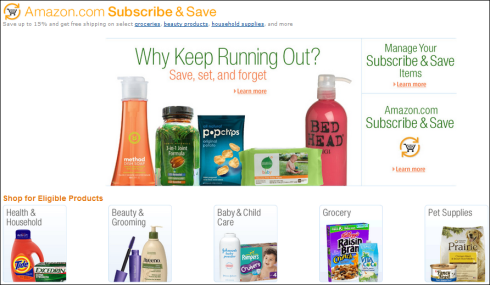
Subscribe to the mom's club on Amazon.com for savings on replenishment products
Until now, I haven’t had much interest in buying groceries online. I dabbled with it during the initial launch of all the online grocer sites, years ago. I couldn’t stand the waste involved with all of the packaging: the laundry detergent came wrapped tightly in cellophane, sunk into a huge box four times it’s size, with loads of those foam peanuts. I ordered two grocery bags worth of stuff, and had enough recycling and garbage to make the garage look like the week after Christmas. Not to mention the size issue. I had never paid much attention to the number of ounces in the average cereal or cracker box- so I ended up with sizes ranging from Brooklyn-corner-store-tiny, to Costco sized gigantic, feed-a-family-of-eight sizes.
But now that I’m commuting again, leaving at 7 and returning after 7, online shopping has a much bigger appeal. I just don’t have enough time to do it all on the weekend.
Last weekend, my sister introduced me to Wag.com, Soap.com– and its associated sites, including diapers.com. Four sites, with a shared cart. Lots of introductory offers, and premium, free 2-day shipping for first time orders. Yesterday I ordered a 35 pound bag of dog food, a 25 pound box of cat litter, a mega-12-pack of paper towels, various organic food items and method soaps, paid nothing for shipping, and it’s all coming tomorrow. Saving the rush trips to store before the weekend is like a gift. Amazon actually owns those sites, too-having acquired the parent company, Quidsi, Inc, for $500 million back in March, but keeps the branding unique and the web design is beautiful. The sites are clean, elegant, and shopper friendly.
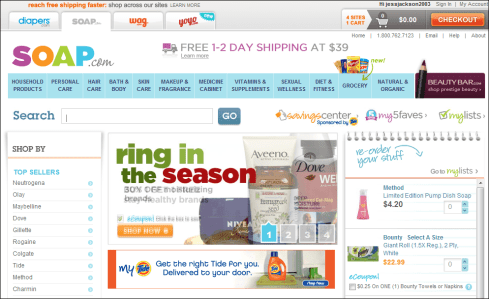
Soap.com remembers what I ordered, and makes it easy to re-order- right from the homepage.
I never thought I’d want to buy paper towels on Amazon. But times have changed. I need easy, now. And getting big, heavy things I need delivered to my door is very, very easy. I’m a convert.
Are you shopping for groceries online? Let me know where you shop, and what you think about the experience.
Retail has become very messy.
It has become a myriad of discounts and ‘exclusive’ events, like the Friends and Family sale, flash sales, sales upon sales, upon sales. I’ve actually started to unsubscribe. The clutter is getting overwhelming, even for me- an inveterate web shopper.
Shoppers are having a field day, now that the entire universe of retail is like one big one-day sale. Want a new pair of pants? There’s a sale for that. New shoes? Wait for the sale. New camera or TV? Just wait for the deals. No one has to pay full price for anything anymore (except maybe orthodontia).
Which is why it is such a delight to see messages from retailers that actually say something. Some good old-fashioned, cogent brand-advertising; something that is actually worth the read. I got one of these today.
It’s an email from Brooks Brothers. What I like about it is that it’s not an in-your-face ‘buy our cashmere because it’s great quality’- pretty much what everyone says. Yes, of course, the ad explains why the cashmere is wonderful. But it draws you in with such a surprising headline, that you actually want to read on. The headline reads:
“The secret to your favorite cashmere sweater and your favorite scotch is the same. It’s in the water.”
It goes on to say,
“What will make our cashmere sweater your favorite? There’s no magic about it– it merely took generations of families on a special riverbank hundreds of years to perfect.”
Oh, is that all. Now they have me engaged. Generations of families? Hundreds of years? A riverbank? It’s starting to sound like an interesting story. Read on- I’ve included the entire email below. Let me know what you think.

Email from Brooks Brothers. Gets your attention in a way most don't anymore.


 jess blogs