Posts from the ‘customer experience’ Category

Trunk Club is a personalized online shopping service for men.
If you’re a man that hates to shop, struggles with fashion sense, or is extremely limited on time-Trunk Club may be the best thing that ever happened to your wardrobe.

Ready for your next shipment? Just text your Personal Shopper, and you’re done.
Trunk Club is a personalized service that handpicks clothing for you- everything from shirts and jeans, to shoes and belts. The best thing is how the service is designed: It’s fast, it’s easy, and it’s tailored to your preferences. Each client is assigned a personal shopper, who will communicate with you as little or as much as you like. You can call, email, text- or even skype. You can specify what you do or don’t want (more black shoes! Only pants…need everything…and so on).
The free service starts with a quick style survey, in which you select your style type (clueless, confident or aficionado), choose from a range of looks and brands that reflect your style, add your measurements- and you’ll be matched with a personal shopper that puts together your first ‘trunk’. The survey takes less than a few minutes.

Shopping just got easier for men: Trunk Club sends you a selection, you choose what to keep.
When you get your trunk, you have 10 days to decide what you want to keep. You can keep it all, or just a portion, and send the rest back.
There are no automatic shipments. You simply call, email or text, when you’re ready for the next shipment.
CEO Brian Spaly started the service because he felt the experience of shopping for most men was too frustrating, overwhelming and time consuming. Before founding Trunk Club, he also founded a company named Bonobos, to create stylish clothing with a superior fit. In solving the problems of fit and shopping, he’s made it easy for men everywhere to avoid the dreaded trip to the mall.
Guys- if you like the idea of never having to shop again, give Trunk Club a try.
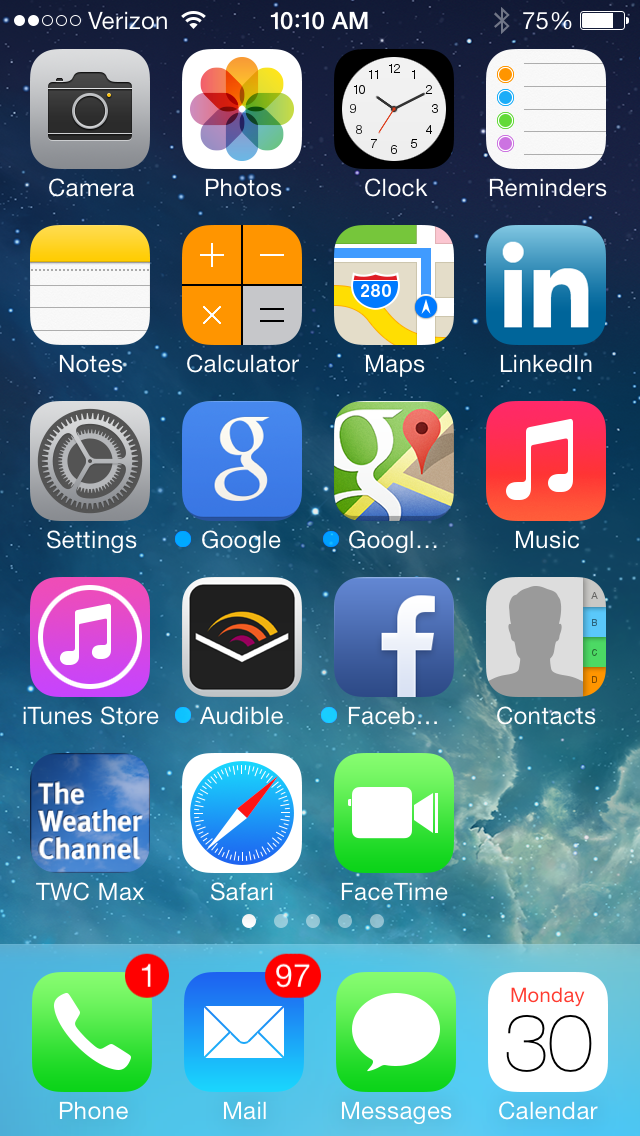
ios7 home screen
ios7 was a long time in the making- and a big move for Apple. It’s the first major break from the iconic visual design driven by Steve Jobs and the warm, homey graphics that made the techie device feel familiar: to-do lists that looked like lined paper, a bookshelf that looked like wood, and most importantly, easy to read text, links and buttons.
In this update, the new flattened design takes flat too far. The text is a pretty pale grey and the links a pretty pale blue, making both hard to read. All links are treated equally, so that “skip this step” and “next” links, for example, look exactly the same. The new tool icons are flat and colorless, which combined with the pale blue outlines- make them hard to distinguish. They just don’t pop off the page. The one that’s highlighted is great- if they were all treated that way, they’d seem less diminutive and more actionable.

I like the idea of modernizing the graphics, but this fails in the execution. The graphics are reminiscent of early web design that was less well attuned to customer experience mandates such as legibility, clear calls-to-action and ease of use. The newstand is still a newstand, and I can’t pull my New York Times out of it, so it continues to be two clicks away. The bookshelf design looks like something you might find in a windows app, with books floating on varying shades of blue. The safari icon looks like a compass. And I can’t find the new ‘easier’ to find spotlight search no matter what I do.
The critical issue: The text and link treatments are too pale. Too subtle. These are key elements of the design- and they need to be made legible.
The good stuff:

Swiping up opens the control panel- for easy access to itunes, sleep, airplane, bluetooth, and other modes.
On the upside, ios7 seems stable and has some great new features. The new control panel is fantastic- it puts key functionality one swipe away, instead of multiple clicks- you can now access sleep, do not disturb, airplane mode- and even a flashlight with a quick swipe. Love that.
The camera is noticably better- with easy controls, and more accessible controls for a panoramic shot, square or video.
And the new App scrolling feature is cool- with two clicks, you get mini screens you can scroll through to see what apps are open and click directly in. Very nice.
There’s lots to like about the new OS release. Though I’m not a fan of how far they took the flattened design, I believe it’s easily fixable. The critical need is to fix the oversimplified text and link treatments. I hope that Apple will recognize the need to do this quickly in upcoming releases. The rest is just a matter of taste.
Your shopping mall just got a little smarter. Now there’s technology that allows stores to track customers movements through a store- where they stop, where they try on, when they buy- or what they look at before they walk out. It’s the same, in concept, to what retailers look at online: the customer path from the time a customer arrives, until the time they leave- what they add to cart, what they look at and for how long, and where they are when they decide to leave. Now stores can mine the same kind of measurable data: conversion (of those who come in, what percentage buys) and abandonment, and a glimpse into what’s generating interest as they walk through the store.
What could be controversial is that this tracking happens via your cellphone signal. If your wireless is on, the store software can ping your phone to keep track of where you are and what you’re doing. Is it an invasion of privacy? While it seems a little unnerving to be followed around like this, it’s really no different than what virtually every website does when you browse a site. And to be fair, we all know that there are abundant video cameras in stores and malls, so it’s not as if we couldn’t be watched before. As with website cookies, if you don’t like the tracking, you can turn it off- in this case, by turning off your phone’s wifi setting.
This technology gives stores the opportunity to better learn from what customers are doing- which, in concept- gives them the opportunity to improve the presentation to better serve customers. If they see that no one stops at the first sets of tables, or that certain racks get missed altogether, it might give them better ideas about how to re-configure the displays. By simply making what people want easier to find, they could sell more. So that could be a win-win.
The problem, as with web analytics, is that the data alone doesn’t give you the whole picture: now you know WHAT people are doing, but you don’t know WHY they’re doing it, or how they’re feeling while they’re doing it. This is still an important problem to solve- the things that make it hard to shop, like too tightly packed racks, or hard-to-find size labels, or a limited size range- these are things that affect my abandonment rate- but tracking my wifi will not reveal that. There’s no substitution for asking your customers what they think- not just the ones that buy- but the ones who don’t buy, too.
Next, we need to develop more sophistication in how we get that data. Surveys are okay for online shopping- but they are often long and tedious. Net-promoter surveys are great, because they ask just two questions: Would you recommend us to a friend? Why or why not?
What I want to see happen is the equivalent to the tapping a word on my kindle to see what it means: I want to see a way to provide feedback in context, in the moment- as it’s happening. That’s going to be the most meaningful information to get. Now that I think of it, when I notice a typo in a Kindle book, I wish there were a simple way to highlight it and send an alert, in the moment, in context. Amazon, take note.
Great service is transformative. I sometimes find myself inordinately grateful and awed by an experience that exceeds my expectations. It just doesn’t happen that often. How often are you WOWed by amazing service? And how often are you infuriated with a lack of reasonably good service? Probably not terribly often, for either one. It seems the norm is somewhere between- most reputable companies will do what’s essentially right- fix something that went wrong, refund your money for a defective product, or replace it. That is simply what we expect. And we’re satisfied with that.

Delivering Happiness by Tony Hsieh
The fact is, extraordinary service requires an equally extraordinary effort. The company has to believe in it- from the top down. Evangelize it. And fund it. Zappos lives the ideal of amazing service. Even their online chats have an extra friendly touch that reminds you you’re talking to a real person, who’s not afraid to deviate from the script. They live service as an ideal. In fact, “Powered by Service” is part of their logo. If you look at the top area of the site- there are 5 friendly messages going on at the same time- ranging from “Free Next day delivery”, to “24/7 customer service by phone or chat”, to “Free Shipping & Returns 365 days a year”…it goes on and on. And they don’t just promise it- they actually deliver on it, exceptionally well. It’s not easy to deliver great service with a level of consistency. Zappos exemplifies the ideal.
Why don’t more companies build a brand on a platform of great service, like Zappos? Most focus on keeping service costs low- maximizing the efficiencies of cost per call, sales $ per call, and so on. Focusing on great service makes it harder to measure success- or at least, makes it much fuzzier. It will cost more to have customer service agents who are inspired and charged with making the customers happy- who are not rushed to get off the phone. It will take more time, potentially cost more in appeasements or expedited shipping. But does it really? Perhaps Zappos has unlocked the deeper metrics of lifetime value for customers who love the experience- who will come back, again and again- who will look to Zappos first, simply because it is such a great experience. Check out Tony Hsieh’s book, “Delivering Happiness” on Amazon, to see how he did it.
Nordstrom is another legendary company with a reputation for amazing customer service. For them, it’s simple- provide customers with the best possible service- and they do so with simple excellence. They are not as over the top as Zappos about being extraordinary. But they are. They do it quietly, and well. You’ll get treated with respect and helpfulness. You’ll get a business card from your sales person. Sometimes even a thank you note in the mail. And you’ll never have any difficulty returning anything- that’s what they’re famous for. The tire legend lives on- whether it’s true or not, doesn’t really matter (for a recap and analysis of the many versions of this legend, see Snopes. I always assumed it was true- now, maybe, not so much. But it doesn’t matter. They live the ideal of service. It’s enough.
I’ve also been impressed with the Amazon Kindle division. I have a family of readers- and we’ve had at least 3 kindles that stopped working within the first year. Even one that went bad within a month. Each time, I’ve been able to resolve the situation with a quick phone call or online chat, getting a new replacement device delivered overnight, with 30 days to return the defective one. The warranty replacements are brand new- not refurbished. These two things make a big impact: overnight replacement, brand new device. When I’ve had to replace in-warranty phones, for example, I always get a refurbished device- which makes me feel a bit cheated.
On the one hand, the consistency of the product quality hasn’t been so great for all our Kindles. But on the other hand, they support the product so consistently and fairly that I’ve never been motivated to switch to a different brand. I’ve never had to escalate an issue with a manger. Never been frustrated by one of these calls. Even the support for out of warranty devices has been pretty impressive. And several of the devices- 2nd generation kindles, have lasted 4 years and are still working. I always feel good about Kindle after one of these transactions, defective products notwithstanding.
It raises an interesting point: we forgive a company its failures if they solve the problem easily and well. When they don’t? Research shows that an unhappy customer tells up to 3 times more people than a happy one. I’m betting that this is understated. When you’re frustrated out of your mind with a bad experience, chances are, you’ll want to talk about it. You may even post it on Facebook- immediately sharing it with a hundred or more of online friends. Or post it on the company’s website, for all its tens of thousands or hundreds of thousands of fans to see. A rabidly unhappy customer is more of a problem now for companies than ever before.
So there’s the great. And the good. And now we’ll give a short moment to the Abysmal.
Abysmal is…a company that will spend 40 minutes on the phone arguing with you about why they can’t help you solve a 2 minute problem.
Abysmal is…a company that employs an outsourced customer service company with people that are neither empowered nor knowledgeable enough to say anything beyond the exact lines on a script, over and over again, with no training for how to deal with an upset customer.
Abysmal is…a customer service agent who is trained to be so scared to escalate to a manager that they insist that there is no manager to speak to.
Abysmal is…waiting on hold for so long that you have to give up.
The companies that allow “abysmal” service, well, those are the ones that either just aren’t paying attention- or are making a fatal mistake. The company that spends 40 minutes telling me why they can’t solve my 2 minute problem is not going to get my business, next time. The company that uses outsourced customer service agents that can’t help and don’t acknowledge that they are not solving the problem, is not likely to get my business again.
Great (or even good) service takes a dedicated and purposeful effort. It goes back to what I’ve always told my staff about building a great website: shop it yourselves, and shop it often, from beginning to end. Forget your password and try to get a new one. Get a delivery and return or exchange it. Live the experience the customers get. That’s the only way you can truly understand what the customer is experiencing. In the words of Mark Hurst, the founder and president of “Creative Good”, an organization dedicated to the art of Customer Experience, and a great proponent of great customer experience, “It’s hard to get people to consider their actions from the perspective of another person. That is the basis of all customer experience work.”
Enough said.
All this bad press about Mike Jeffries and his reprehensible statements has created a firestorm in social media. Has he gone too far this time? Well, yeah. He always does. But…
Is Abercrombie bad because of what he said, or because of what they do?
Indeed, his comments are awful. While I could argue that Abercrombie’s aspirational brand vision goes too far (something that’s been hotly debated for years- ever since they launched the magalog with naked teens on the cover), it’s not a new marketing tactic to use shock-value to get media attention. Abercrombie has always pushed the limits, and in fact, revels in going over. But they’re not really doing anything new, now. They’ve always marketed the brand for cool, skinny people. They’ve always had teeny-weeny little sizes that could fit your toddler. So why is everyone so hopping mad about it, now?
Because he crossed the line. He didn’t just cross it, he leapt over it. He said what no one would say. And defies the ideals of inclusion, acceptance and diversity. In the 2006 Salon feature that’s been so widely publicized this past few weeks, the interviewer asks him how important “sex and sexual attraction are in what he calls the ’emotional experience’ he creates” and Jeffries says:
“It’s almost everything. That’s why we hire good-looking people in our stores. Because good-looking people attract other good-looking people, and we want to market to cool, good-looking people. We don’t market to anyone other than that.”
“In every school there are the cool and popular kids, and then there are the not-so-cool kids,” he says. “Candidly, we go after the cool kids. We go after the attractive all-American kid with a great attitude and a lot of friends. A lot of people don’t belong [in our clothes], and they can’t belong. Are we exclusionary? Absolutely. Those companies that are in trouble are trying to target everybody: young, old, fat, skinny. But then you become totally vanilla. You don’t alienate anybody, but you don’t excite anybody, either.”
(“The man behind Abercrombie & Fitch“, Benoit Denizet-Lewis for Salon, 2006)
Is this exclusionary strategy so different from other high profile fashion brands? Or is he just brutally honest? Let’s focus on the sizing issue. Abercrombie’s sizing is notoriously small. It doesn’t carry extra large sizes for women at all. Even the men’s sizes are downsized: a men’s size XL sweatshirt fits like a women’s size 12.
If you look at the sizing for many upscale fashion retail brands, it’s not really that different. Abercrombie defines a Large as equivalent to a size 10. Many fashion brands define a large as a size 10-12. Some go even smaller, defining it as an 8-10. And others (the less trendy) define it as a 12-14 or even a 14-16. There’s no standardization for sizing, and we all know it, as frustrating as it is. It always differs by brand. Some are just cut slim- others more generous. We all know the brands we can wear, and the ones we can’t. So Abercrombie is hardly unique when it comes to size range.
Considering the brand issue, Abercrombie is not unique in having a passionate and specific vision of its aspirational lifestyle and target customer. Countless fashion brands have an aspirational look that celebrates, young, thin, beautiful women, with a target customer that exemplifies the aspirational lifestyle. That’s not news. The key difference? Most brands don’t celebrate the exclusion. What’s hateful about the Jeffrie’s incident is that he didn’t focus on what’s good about his brand- he focused on what’s bad about the people that don’t fit into his brand image. And that’s bad business.
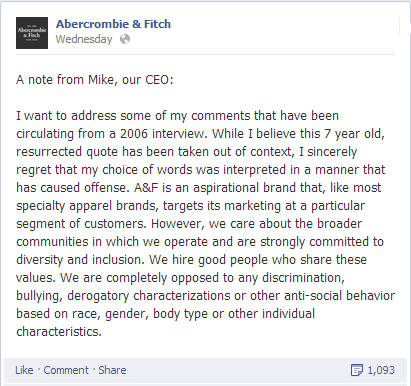
Jeffries has since posted an apology on facebook that reads:
“I want to address some of my comments that have been circulating from a 2006 interview. While I believe this 7 year old, resurrected quote has been taken out of context, I sincerely regret that my choice of words was interpreted in a manner that has caused offense. A&F is an aspirational brand that, like most specialty apparel brands, targets its marketing at a particular segment of customers. However, we care about the broader communities in which we operate and are strongly committed to diversity and inclusion. We hire good people who share these values. We are completely opposed to any discrimination, bullying, derogatory characterizations or other anti-social behavior based on race, gender, body type or other individual characteristics.”
This isn’t the first time Jeffries has hurt the brand he worked so hard to build. He’s been dragged through the mud on many other occasions for discrimation against…well, just about every group except his target audience. So far, Abercrombie has always weathered the storm. But I wonder, will the cool kids really want to keep buying into this? Time will tell.
Everything we do online is tracked- by someone, or some entity. We all know it. Mostly, we accept it.
I don’t get too worked up about it. On the business side, retailers see it as a way to create a better experience for you. Executed thoughtfully, it can be. For example, if you come to a website and look at brand “A”, and add something from brand “A” to your cart, the retailer may send you emails about “brand A” in the future, knowing that it’s something that has interested you. This isn’t such a bad thing, though sometimes it can be misguided (as when you send someone a gift from a website that you also shop for yourself, and forever after get emails about that gift product or brand that you have no further interest in).
I’m not terribly offended by ‘stalker’ ads- banner ads from retailers, which seem to follow you around as you browse news sites or content sites, showing you an ad based on products you’ve recently viewed on a given website. I don’t mind these, because they seem like they could be a coincidence. I don’t even mind getting an email from a retailer I’ve visited recently, showing me the product or brands I’ve looked at. Could also be a coincidence…although a little spooky when it’s exactly what I was looking at. And when I’ve added things to my cart, and then left the site, I don’t mind getting the email saying, “we’ve saved your cart for you.” It seems credible that they know I have an interest in that stuff. Of course they just want to capture the sale. But maybe that’s ok- maybe I want to complete the purchase. Especially if they include a shipping or cart discount to encourage me.
Most retailers are careful to stay within the limits of what’s legal or within best-practices for protecting customer privacy. But there’s fuzzy territory when retailers try new things, or cross the line between what seems reasonable, and what seems invasive. What I mind, is when it all seems a bit too purposeful. A bit too obvious. When you think you’re anonymous, and then get called out by the retailer on it. Here’s an example:
I recently visited a website, looked around, and left. Never signed-in. A little while later, I get an email saying, “Glad you checked us out! Come on back….”
That’s just creepy.
Anonymity doesn’t exist anymore, online. There are measures we can take to protect our privacy, to a degree. If you block cookies, or clear cookies before shopping a website, the session can’t be tracked. But this isn’t top of mind on a daily basis, both because there’s not usually a problem, and because clearing cookies is inconvenient. At the end of the day, retailers are just trying to make money. And I want them to. Because then there are lots of jobs for lots of people.
So retailers: don’t forget you make money by making your customers feel good about you: your brand, your stuff, andIs a the experience. Don’t make me feel like you’re looking over my shoulder- or I won’t want to come to your store anymore. It’s that simple. I expect my information to be treated fairly, and thoughtfully.
And readers…What privacy issues rankle you most? How has it changed what you do online, if at all? I’d be interested in your experiences with privacy (or lack thereof).
Think old-school office supplies are on the way out? Paperless offices, Evernote, iPads, laptops, iPhones- there are so many ways to plug in and make your to-do’s a scheduled reminder list, your notes an archivable, searchable library on Evernote, or a quick email after a meeting. But the truth is, there are die-hard note-takers out here. There are paper lovers and pen collectors. There are those of us who are on a never-ending quest for the perfect pen, the perfect notebook- the proverbial blank page that invites and inspires and satisfies as you check off your to-do list, like no program, application or device can.
This is where Poppin comes in.

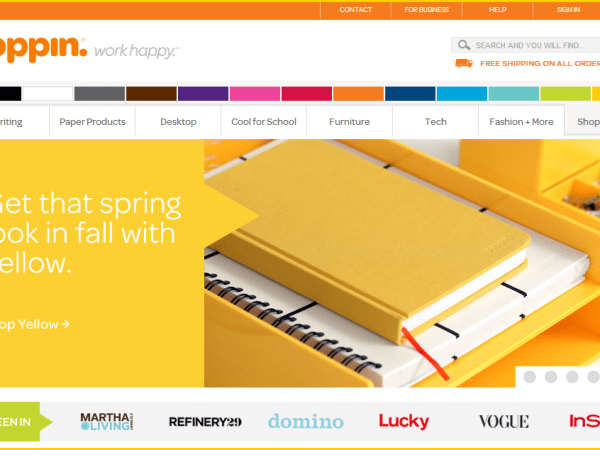
Who says office supplies need to be black? Poppin’s site is all about color.
Of course, we need our technology, and we love that too. This is different. This is love at first sight.
Poppin’s tagline is “work happy”, and everything about the website reflects it. The copy is light-hearted and friendly- The people you can call for help are called “work stylists” who can set you up with a desk to love. On the Help page, the stylists are described this way:
“Each Poppin Work Stylist has been carefully chosen because they like to smile, have exquisite taste and looooove talking to people.”
The website itself is entertaining, fun and has a great design sensibility- you can shop visually by color as a secondary navigation bar at the top of the site. The copy is believable and genuine, with a sense of humor. They “pinky-promise to take any Poppin product back that does not make you work happy.”
The branding is superb, end-to-end. The package arrives with writing on the outside, and air-bubbles on the inside printed with funny quotes. You actually want to save the air bubbles- they’re that cute. And a week or two after my package arrived, I got a hand-written thank you note on a Poppin card, mentioning my specific items.
All in all, it’s a complete delight. It’s not to say we won’t keep using Evernote and iPads and laptops. But it doesn’t hurt to have a desk that makes you smile everyday. Check it out at Poppin.com.
The dreaded VRU. How did it come to be such a brick wall? It’s a great tool for efficiency, of course- just not for us. No doubt it saves millions in staffing costs for companies, while creating a tedious, frustrating, and mind-numbing experience for those of us who spend infinitely more time navigating through the gauntlet of menus, only to find that none of them offer the right options- none offer a human. I’ll start to feel my blood pressure rising, the frustration growing, finally talking louder and louder to the VRU, as if I were talking to someone hard of hearing, saying, “I WANT A HUMAN!”, then getting the inevitably even-toned “I’m sorry, that is not a valid response. To return to the main menu, please press 1, now”.
It wouldn’t be so bad if there were always the option to speak to an agent, but many companies remove that option. Others offer it, but only after you’ve followed a path of automated responses that exhaust all possible functions the system has in its arsenal. The thing is, I don’t actually want to speak to a human. I’d much rather be able to solve everything through email or online. But sometimes, you can’t- and you really need to speak with someone, and it just shouldn’t have to be so hard.
Used the way they were intended, VRU’s have a place, providing answers to frequently asked questions, saving time and money- theoretically leaving more time for qualified agents to deal with more complicated issues. I get it. They can be a tolerable evil, to a degree, as long as there’s always the option to speak to someone. It’s just plain irresponsible to omit an option to do so.
In the early days of web shopping, you practically had to have connections to get a phone number at Amazon. There was one- but you could not find it on the site. It simply wasn’t there. When my friend AMB got the number- it was a big score- and we all saved it in our address books for future reference. It was like having privileged information. They’ve come a long way since those days.
Even now, there are a surprising number of high-profile companies that don’t provide phone service at all. Companies that just can’t handle the volume, or plain don’t want to. Some surprisingly big companies in the mix. See “Tech Companies Leave Phone Calls Behind” in yesterday’s New York Times- Quora doesn’t provide a phone number at all. Twitter has one, but it hangs up after directing you to email. Facebook is no better. In the article, Amy O’Leary describes the Linked In VRU cycle as a telephonic version of “Groundhog Day”. That pretty much sums it up.
And then…there are the times that speaking to an agent seems almost as existential as working your way through a VPU. Check out “The Theater of the Absurd” today in the NYT business section, for a humorous article on the subject, including a transcript of a baffling conversation between Alan Alda and a McAfee customer service agent, in which he says to her, “I am now in the land of Kafka” after going around in ridiculous circles. Worth a read.
I wonder if Siri could help. Try asking her to get you an agent at <company name here>, and see what happens. Let me know how that works out. I’m a generation behind, on the iPhone 4, so wouldn’t know. It would be worth the upgrade if she has that kind of power.
Making your brand extraordinary isn’t about the grand gestures. You don’t have to be a $500 million company to create meaningful moments for your customers. And you can be any size at all to fail your customers in the blink of an eye.
A pass? Providing your full attention in the moment. Acknowledging the customer who is waiting. Saying ‘thank you’. A little surprise, like a Reward card or a sample in the box. Saying ‘yes’ instead of ‘no’.
Epic fail? A scornful response to an angry or annoying customer. Thinking the customer is stupid. Not finding it important to make each contact a positive one. Forgetting that the customer is why you get paid to show up at all.
We always say it’s the little things that make a difference, and yet it’s so easy to forget as we go about our days, with all the accumulated stresses and pressures that we’re dealing with, to make the effort to listen, to really hear, and to respond thoughtfully and generously. The people and companies that become legendary are the ones who are able to make the minutes count. Even the bad ones. But how do they do it? It starts with a clear, focused mission that puts the customer at the forefront. Consistent performance. A culture that sustains thoughtfulness as a value, even behind the scenes.
Have you every noticed how delighted you are when someone gives you what you want, right away, with a smile- even when you want to return something too late, or with the tags off, or you’re being antagonistic because you expect a ‘no’, and then you get a friendly ‘yes’? It’s a nice surprise. It can make you feel so great about an experience, and yet it’s really just such a small thing. It’s not easy to be that person who smiles and remains friendly when someone’s being difficult and antagonistic, when viscerally, you just want to respond in kind.
That’s what makes it special. It’s harder to be nice sometimes, but it’s a win-win for everyone. For a brand, it can create buzz. It can make you remarkable. And your customers will so happily want to bring friends to you, because it’s surprising and wonderful, and makes a difference in their day.
It reminds me of something that happened last week on the way home. Every day I commute to and from work on the bus. I completely zone out, reading or sleeping the entire way home. It’s the same, day after day. Except one night, last week, we pulled to the back of the parking lot, where the headlights showed a racoon- yes, a real racoon, standing inside a plastic storage box turned sideways, eating out of a Chinese food container. The next night, he was there again, eating from a new one. Now, every few days, we drive that way to see if he’s home. And usually, if we’re there at the same time, he is. Someone is bringing Chinese food to that Racoon. Or he’s having it delivered. Or he’s found a friendly, neighborhood garbage to raid. The point is- it was an extraordinary thing to see in the vast paved parking lot with hundreds of cars and people going about their daily commute. Just hanging out, in all his fuzzy glory, eating his lo mein.
It made us smile. And we’ve talked about it ever since. But really, it was just a racoon. What’s so special about that? It’s just that it was so unexpected. So out of context. It was remarkable.
A great customer experience is like that Racoon. It becomes something worth talking about.


 jess blogs